

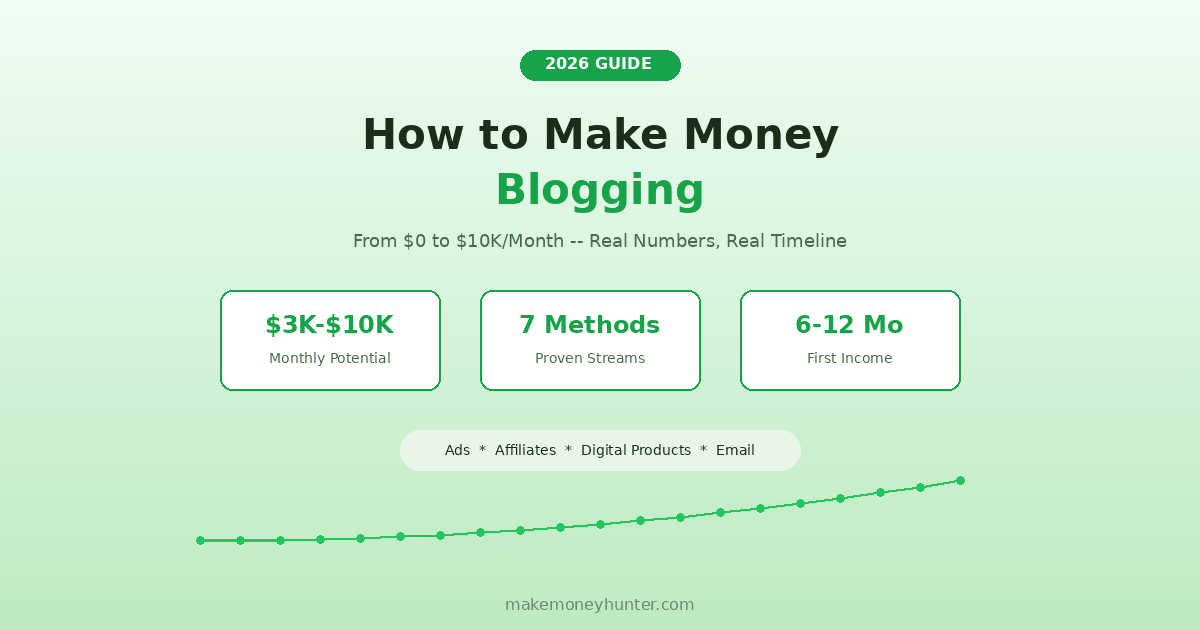
The short answer: through a mix of display ads, affiliate commissions, digital products, and sponsored content. A well-run blog with 50,000 monthly visitors can realistically generate $3,000 to $10,000 per month. But the honest answer is more nuanced than that — and most guides skip the part that actually matters.
My third blog failed. Not dramatically — it just sat there for five months with 47 posts, earning $11.23 total from AdSense. I remember staring at that dashboard thinking I’d wasted half a year. What I didn’t realize then was that I’d made the same mistake 90% of new bloggers make: I was writing about topics nobody was searching for, with no plan to actually monetize the traffic I wasn’t getting.
That was 2011. Since then, I’ve built and sold two niche sites, grown makemoneyhunter.com from zero, and generated over six figures from blogging across different projects. The blogging income landscape in 2026 looks different from even two years ago — AI tools have changed how content gets created, Google’s algorithm updates have reshaped what ranks, and new monetization channels have opened up. But the fundamentals of how to make money blogging haven’t changed at all.
This guide breaks down every proven method, with real numbers, honest timelines, and the specific steps I’d follow if I were starting from scratch today.
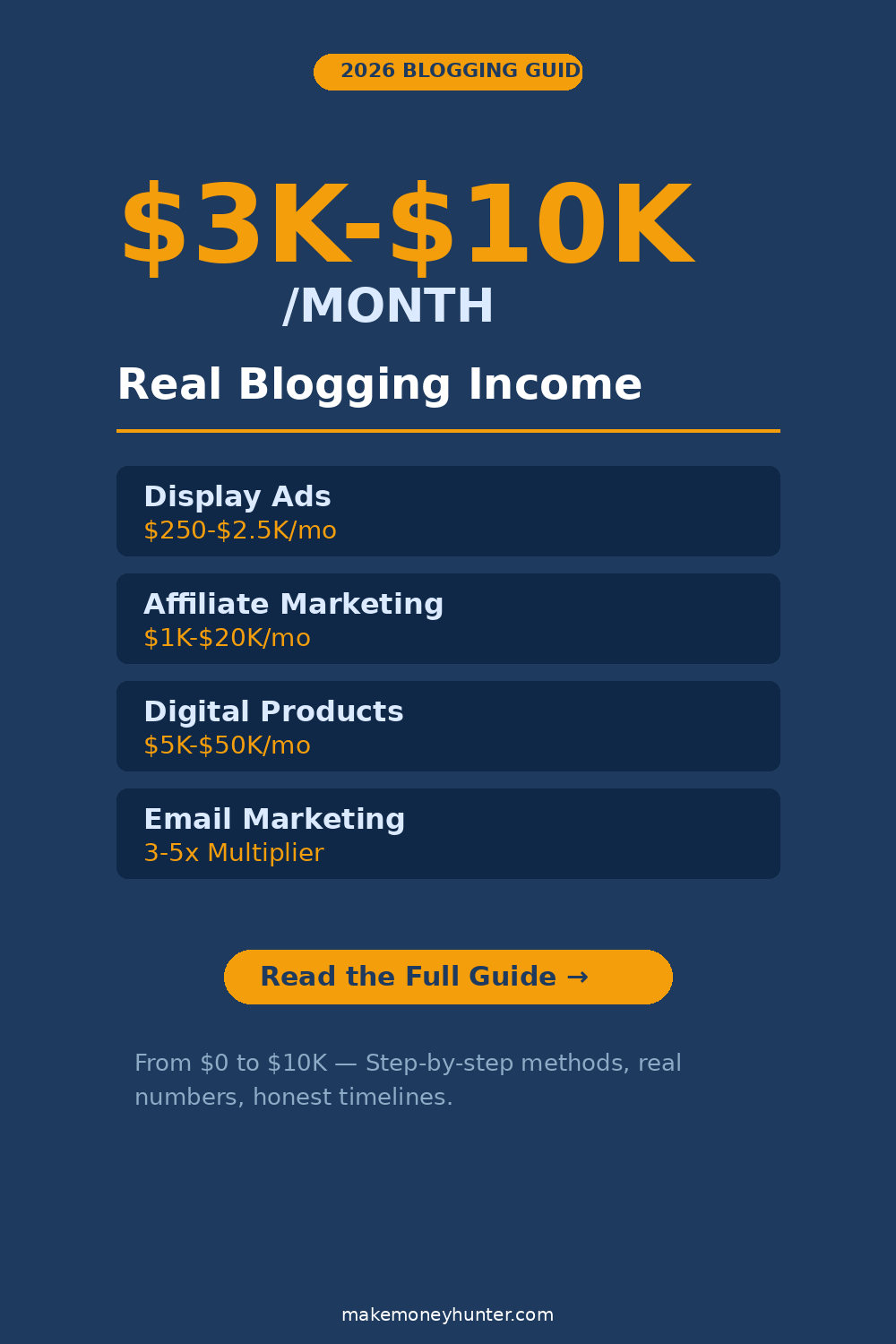
📌 Think of this pin as your cheat sheet. Save it now, and you’ll have all these tips at your fingertips whenever you need them.
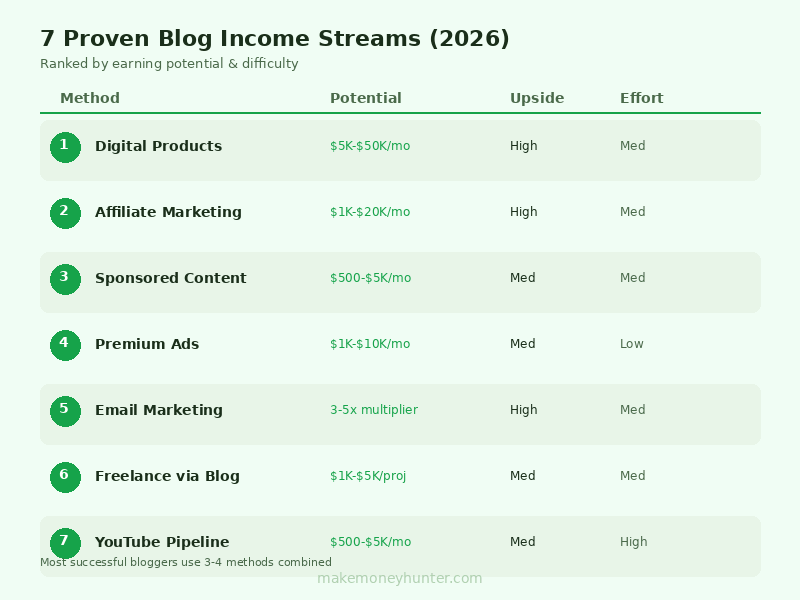
How Does Blogging Make Money? The 7 Proven Revenue Streams
Before jumping into the how-to, you need to understand where the money actually comes from when you run a blog. Every successful blog I’ve seen — mine included — uses a combination of these revenue streams, not just one.
1. Display Advertising (AdSense, Mediavine, Raptive)
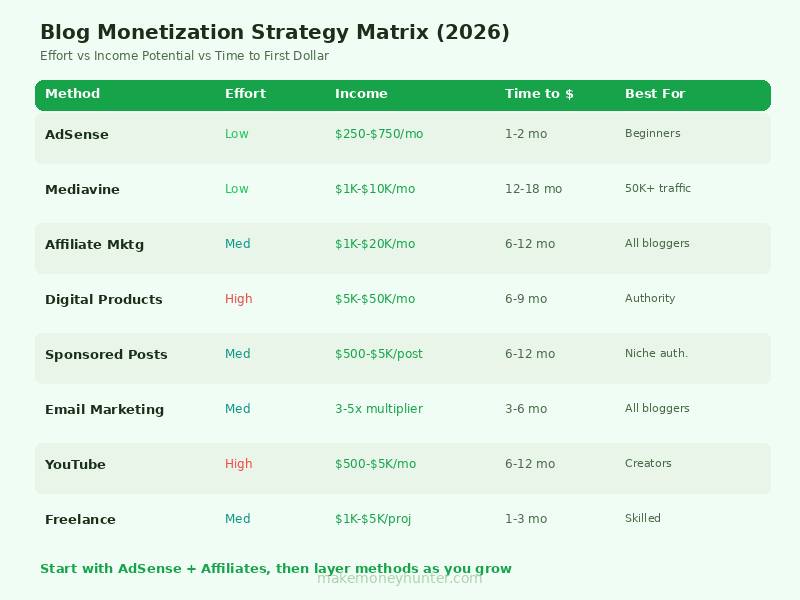
This is the most passive way to earn from a blog. You place ads on your site, and you get paid based on impressions (how many people see the ads) and clicks. The key metric is RPM — revenue per 1,000 pageviews.
Here’s what realistic RPMs look like in 2026:
| Ad Network | Traffic Requirement | Typical RPM | Monthly Income at 50K Pageviews |
|---|---|---|---|
| Google AdSense | None | $5–$15 | $250–$750 |
| Mediavine | 50,000 sessions/month | $20–$40 | $1,000–$2,000 |
| Raptive (formerly AdThrive) | 100,000 pageviews/month | $25–$50 | $1,250–$2,500 |
The math is straightforward: more traffic = more ad revenue. But there’s a ceiling. Display ads alone won’t make you rich unless you’re pulling 500,000+ pageviews per month. That’s why most successful bloggers treat ad revenue as their baseline income and layer other monetization methods on top.
My take: Start with AdSense when you’re new. Apply to Mediavine once you hit 50,000 sessions. The jump from AdSense to Mediavine typically doubles or triples your ad income overnight — it was the single biggest income boost I experienced in my first two years of blogging.
2. Affiliate Marketing
Affiliate marketing is where you recommend products and earn a commission when someone buys through your link. This is where most bloggers make the majority of their income, and it’s the revenue stream with the highest upside relative to effort.
The commission structures vary wildly:
- Web hosting (Bluehost, SiteGround): $65–$200 per signup
- WordPress themes and plugins: 30–50% recurring commissions
- Online course platforms (Teachable, Kajabi): $100–$500 per sale
- Amazon Associates: 1–10% per sale (low per transaction, but high volume)
- Software tools (SEO tools, email marketing): $50–$200 per sale, often recurring
The key insight most people miss: affiliate income is driven by search intent, not traffic volume. A blog post targeting “best web hosting for beginners” with 500 monthly visitors can out-earn a general “what is web hosting” post with 10,000 visitors. The first group is ready to buy. The second group is just browsing.
In my experience, affiliate marketing starts generating meaningful income ($500+/month) once you have 15–20 well-optimized articles targeting buyer-intent keywords. It took me about 8 months and 47 articles to hit $1,000/month consistently from affiliates alone.
3. Digital Products
Selling your own digital products — ebooks, templates, printables, online courses, or membership content — is where profit margins get serious. You keep 90–100% of the revenue instead of earning a commission.
Common digital products for bloggers:
- Ebooks and guides: $17–$47, low effort to create, easy to sell through blog posts
- Templates and printables: $5–$29, great for Pinterest traffic
- Online courses: $97–$497, highest revenue per sale but most effort to create
- Membership sites: $9–$49/month, recurring revenue
I launched my first ebook — a blog income blueprint — after publishing about 30 articles. It wasn’t fancy. Just a PDF with actionable steps. It generated $1,400 in its first month with zero paid advertising. The key was timing: by the time I launched it, I already had an audience that trusted my advice because they’d been reading my free content for months.
4. Sponsored Content
Brands pay you to write about their products or include them in your content. Rates depend on your traffic, niche authority, and audience engagement. A blog with 50,000 monthly visitors can charge $500–$2,000 per sponsored post in most niches.
Most people think about this one, but it’s actually my least favorite monetization method. It’s time-intensive, requires negotiation, and you’re trading time for money instead of building passive income. That said, it’s solid supplementary income if you’re selective about which brands you work with.
5. Email Marketing and List Building
Your email list is the asset that makes everything else work better. It’s not a direct revenue stream — it’s a multiplier for every other monetization method.
Every time you publish a new blog post, promote an affiliate product, or launch a digital product, your email list turns “publish and hope” into “publish and profit.” Bloggers with a 5,000+ subscriber email list consistently report 3–5x higher conversion rates on affiliate offers compared to relying on organic traffic alone.
Start collecting emails from day one. Even before you have anything to sell. A simple lead magnet — a free checklist, template, or mini-guide related to your niche — is enough to get started.
6. Freelance Services Built on Blog Authority
Here’s one most guides don’t mention: your blog can function as a portfolio that attracts high-paying freelance clients. If you write about web design and your articles rank on Google, potential clients find you organically. You don’t need to pitch — they come to you.
This works especially well in the first 6–12 months when your blog traffic is still growing. Instead of waiting for passive income to kick in, you can use your blog content to land $1,000–$5,000 freelance projects in your area of expertise.
7. Ad Revenue from YouTube (Blog-to-Video Pipeline)
This is a 2026-specific strategy that’s working well. Take your top-performing blog posts, turn them into YouTube videos, and earn ad revenue from both platforms. The blog feeds the channel, the channel feeds the blog. Double the content distribution, double the income potential.
Bloggers who add a YouTube channel typically see a 40–60% increase in total revenue within 12 months. You don’t need to be on camera — screen recordings, slide presentations, and voiceover formats all work.
How to Start a Money-Making Blog: Step-by-Step
Now that you understand where the money comes from, here’s how to actually build a blog that generates income. I’m going to give you the exact sequence I’d follow if I were starting over in 2026.
Step 1: Pick a Profitable Niche (Don’t Skip This)
Most people think about this, but they think about it wrong. The question isn’t “what am I passionate about?” The question is: “Is there a niche where I have knowledge, people are searching for answers, and companies are willing to pay for referrals?”
All three conditions must be true. Passion without search demand means nobody finds your content. Search demand without commercial value means traffic that doesn’t pay. Commercial value without your knowledge means content that doesn’t ring true.
Profitable blogging niches in 2026 (based on affiliate commission potential and search volume):
- Personal finance and investing
- Health and wellness (specific sub-niches, not generic)
- Technology and software reviews
- Online business and marketing
- Home improvement and DIY
- Travel (budget travel, specific destinations)
- Food (recipe blogs with kitchen product affiliates)
- Parenting (baby products, educational tools)
The biggest mistake I see: choosing a niche that’s too broad. “Health” is not a niche. “Gut health for women over 40” is a niche. The narrower you go, the faster you can build authority and start ranking on Google.
Step 2: Set Up Your Blog on WordPress
Use WordPress.org (self-hosted) — not WordPress.com, not Wix, not Squarespace. WordPress.org powers 43% of the internet for a reason: it’s the most flexible, SEO-friendly, and monetization-ready platform available.
Here’s what you need to get started:
- Web hosting: Bluehost ($2.95/month for beginners) or SiteGround ($3.99/month for better performance). Either works fine for your first year. You can always upgrade later.
- Domain name: Choose something memorable and brandable. Avoid hyphens and numbers. $10–$15/year through your hosting provider.
- WordPress theme: GeneratePress or Astra (free versions are excellent). Don’t spend weeks picking a theme — pick one and start writing.
- Essential plugins: Yoast SEO (or Rank Math), an image compression plugin, and a caching plugin for speed.
Total startup cost: $50–$100 for your first year. That’s it. Anyone who tells you that you need to spend thousands to start a blog is trying to sell you something.
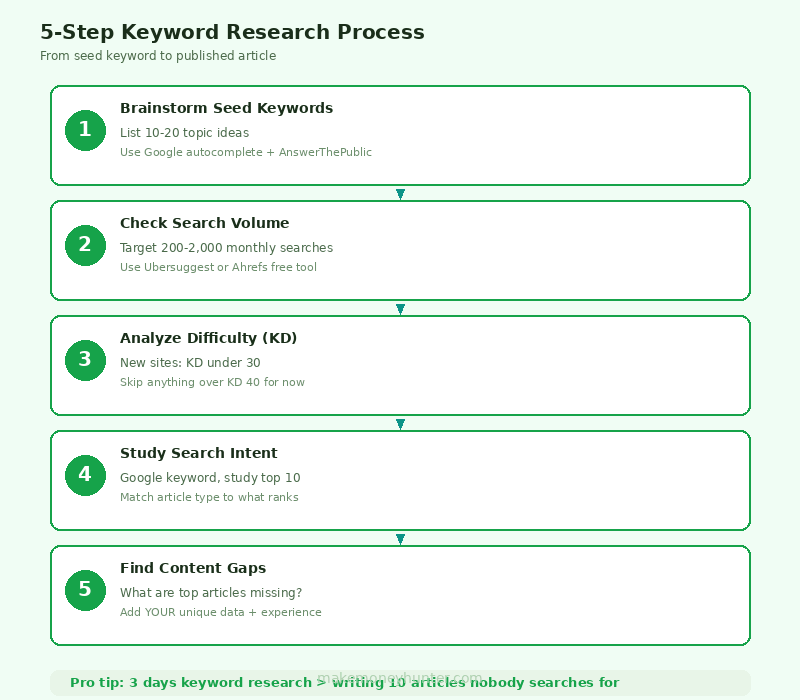
Step 3: Do Keyword Research Before You Write Anything
This is where 90% of new bloggers go wrong. They open WordPress and start writing about whatever comes to mind. That’s like opening a restaurant and cooking whatever you feel like eating — without checking if anyone in the neighborhood wants to buy it.
Keyword research tells you exactly what your target audience is searching for, how many people are searching for it, and how hard it will be to rank for those terms.
Free tools to start with:
- Google Keyword Planner (free with a Google Ads account)
- Ubersuggest (free tier gives you basic data)
- AnswerThePublic (shows you questions people are asking)
- Ahrefs Free Keyword Generator (limited but useful)
When you can afford it, invest in SEMRush or Ahrefs ($99–$129/month). These tools pay for themselves once your blog starts earning. They show you exactly which keywords your competitors rank for, which ones have low competition, and where the content gaps are.
For your first 20 articles, target keywords with:
- Monthly search volume: 200–2,000 (enough traffic to matter, not so much that competition is brutal)
- Keyword difficulty: Under 30 (realistic for a new site to rank)
- Clear search intent (you can tell what kind of article the searcher wants)
Step 4: Write Content That Actually Ranks
Good content isn’t just well-written. It’s content that matches search intent better than anything else on page one of Google.
Before writing any article, Google your target keyword and study the top 10 results. Look at:
- What type of content ranks? (tutorials, lists, comparisons, reviews)
- How long are the top articles? (your article should be at least as comprehensive)
- What topics do they all cover? (you need to cover these too)
- What topics do they miss? (this is your opportunity to add unique value)
Then write something that covers everything they cover, fills the gaps they miss, and adds your personal experience and data. That last part — your unique perspective — is what Google calls “information gain.” It’s the single most important ranking signal in 2026, and it’s the one thing AI-generated content can’t replicate.
Content structure that works:
- Hook opening (2–3 sentences that grab attention)
- Direct answer to the question in the first 200 words
- H2 and H3 subheadings every 300–500 words
- Short paragraphs (2–4 sentences each)
- Tables, lists, and images to break up text walls
- FAQ section at the end (AI search engines love this format)
Step 5: Build a Content Strategy Around Topic Clusters
Don’t write random articles. Build topic clusters.
A topic cluster is a group of related articles linked together, with one comprehensive “pillar page” at the center. This strategy tells Google: “This website is an authority on this entire subject, not just one random keyword.”
Example for a blogging niche:
- Pillar page: “How to Start a Blog” (comprehensive, 4,000+ words)
- Cluster articles: “Best Blogging Platforms,” “How to Choose a Blog Niche,” “Blog Post Ideas for Beginners,” “How to Write a Blog Post,” “WordPress vs Squarespace,” etc.
- Each cluster article links back to the pillar page, and the pillar page links to all cluster articles
In my experience, blogs that use topic clusters start ranking 2–3x faster than blogs that publish disconnected articles. Google rewards depth and organization.
Step 6: Monetize Strategically (Not Desperately)
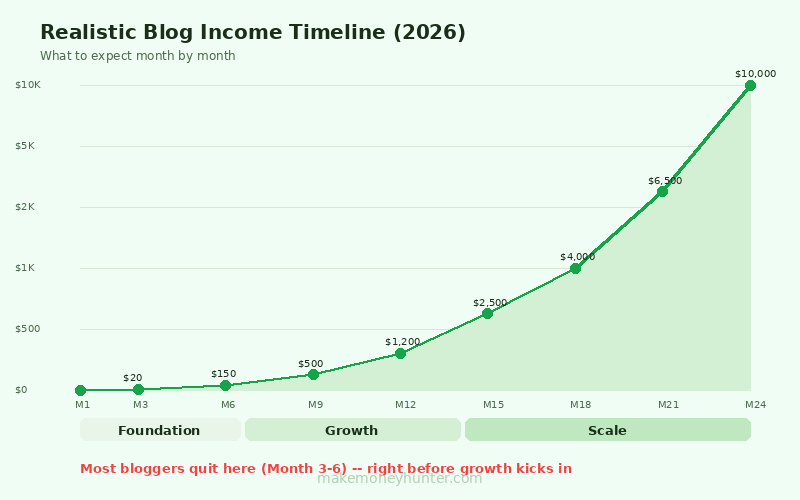
Here’s the blogging monetization timeline I recommend:
Month 1–3: Foundation phase
- Focus 100% on publishing quality content (aim for 2–3 articles per week)
- Set up Google AdSense (it won’t earn much yet, but get it running)
- Start building your email list with a simple lead magnet
- Apply to 2–3 relevant affiliate programs
Month 4–8: Growth phase
- Continue publishing, now targeting more buyer-intent keywords
- Add affiliate links to existing content where they fit naturally
- Create 1–2 “best of” or comparison articles (these are affiliate goldmines)
- Start repurposing content for Pinterest and/or YouTube
Month 9–12: Scale phase
- Apply to Mediavine or Raptive once you hit their traffic thresholds
- Launch your first digital product (ebook or template)
- Optimize top-performing articles for higher conversions
- Consider adding sponsored content as a supplementary income stream
How Much Money Can You Realistically Make Blogging?
Let me give you honest numbers, not Instagram-worthy ones.
| Blog Stage | Monthly Traffic | Monthly Income Range | Typical Timeline |
|---|---|---|---|
| Beginner | 0–10,000 pageviews | $0–$500 | Month 1–6 |
| Intermediate | 10,000–50,000 pageviews | $500–$3,000 | Month 6–18 |
| Advanced | 50,000–200,000 pageviews | $3,000–$15,000 | Month 18–36 |
| Professional | 200,000+ pageviews | $15,000–$100,000+ | Year 3+ |
These ranges are based on a mix of ad revenue, affiliate income, and digital products. The wide range at each level reflects the massive difference between bloggers who just publish content and bloggers who strategically optimize for revenue.
Here’s the truth most gurus won’t tell you: the first 6 months are brutal. You’ll work hard and earn almost nothing. This is normal. Blogging income is front-loaded with effort and back-loaded with reward. The work you do in months 1–6 generates the income you earn in months 12–24. It’s a seed-planting business, not a paycheck job.
What Separates Bloggers Who Earn $10K/Month from Those Who Quit?
After 15 years in this space, I’ve watched hundreds of bloggers start and only a handful reach significant income. The difference isn’t talent or luck. It comes down to five things:
1. They treat keyword research as the most important task. Not writing, not design, not social media — keyword research. Spending 3 days researching one keyword is worth more than writing 10 articles nobody searches for.
2. They pick one monetization method and go deep. New bloggers try to do everything at once — ads, affiliates, courses, coaching, sponsorships. The ones who succeed pick affiliate marketing OR digital products and master that one channel before adding others.
3. They focus on 20 great articles, not 200 mediocre ones. I’d rather have 20 articles that rank on page one than 200 articles buried on page five. Quality compounds. Quantity just fills a database.
4. They update old content instead of only publishing new content. Your best-performing articles deserve regular updates — new data, new screenshots, current pricing, fresh examples. A single article update that bumps you from position 8 to position 3 can double that article’s income overnight.
5. They have patience measured in years, not weeks. Every blog that earns $10,000+/month was once a blog earning $0. The bloggers who reach that level aren’t smarter — they just didn’t quit during the six months when nothing seemed to be working.
How AI Is Changing Blogging Income in 2026
I’d be dishonest if I didn’t address the elephant in the room. AI tools like ChatGPT have fundamentally changed how bloggers create content. Here’s my take on what this means for blogging income:
What AI helps with: Research speed, outline creation, first drafts, repurposing content into different formats, and scaling output. I use AI daily in my workflow — it saves me roughly 40% of my writing time.
What AI can’t replace: Personal experience, original data, genuine opinions, and the trust that comes from a real human sharing real results. Google’s algorithm is getting better at identifying AI-generated content that adds nothing new. The blogs winning in 2026 are the ones using AI as a tool while still injecting real expertise, real numbers, and real stories.
The bottom line: AI makes it easier for everyone to produce content. That means the bar for quality has gone up, not down. Generic, AI-only content is becoming a commodity. Personal experience and original insights are becoming more valuable, not less.
Common Mistakes That Kill Blog Income (And How to Avoid Them)
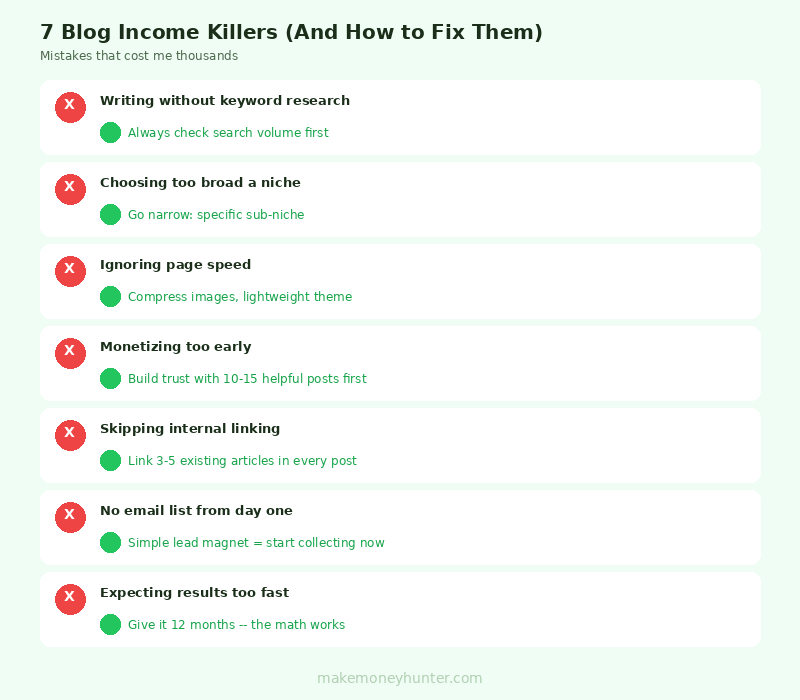
I’ve made most of these mistakes myself. Learn from my expensive education:
Writing without keyword research. I spent my first three months writing articles that nobody searched for. Three months of work, zero organic traffic. Always check search volume before you write.
Choosing a niche that’s too broad. “Lifestyle” is not a niche. “Budget travel for solo female travelers” is. The narrower your focus, the faster Google sees you as an authority.
Ignoring page speed. A slow blog loses readers and rankings. Compress your images, use a lightweight theme, and get decent hosting. If your page takes more than 3 seconds to load, you’re losing 40% of visitors before they even see your content.
Putting affiliate links everywhere on day one. Build trust first, monetize second. Readers can smell desperation. Your first 10–15 articles should focus purely on being helpful. The affiliate links come after you’ve earned credibility.
Skipping SEO basics for internal linking. Every new article should link to 3–5 of your existing articles. Internal links tell Google which pages are most important and keep readers on your site longer. Most new bloggers completely ignore this.
Expecting results too fast. Blogging typically takes 6–12 months to generate consistent income. If you need money next week, get a freelance gig. If you want income that grows while you sleep, build a blog. Different timelines for different goals.
Is Blogging Still Worth It in 2026?
Yes — but only if you approach it as a business, not a hobby.
The bloggers earning real money in 2026 aren’t the ones who write when inspiration strikes. They’re the ones who do keyword research, publish consistently, optimize for conversions, and build profitable monetization strategies from day one. It’s less romantic than “following your passion,” but it’s significantly more profitable.
The opportunity hasn’t shrunk — it’s shifted. There are now more ways to monetize a blog than ever before. But competition has increased too, which means the lazy approach doesn’t work anymore. You need a strategy, not just a domain name.
Frequently Asked Questions
How long does it take to make money blogging?
Most bloggers start seeing meaningful income ($500+/month) between months 8 and 14, assuming they publish 2–3 quality articles per week and target keywords with real search demand. Some niches are faster (finance, tech) and some are slower (travel, food). The biggest variable isn’t the niche — it’s consistency.
Can you make $1,000 a month blogging?
Yes, and it’s a realistic first milestone. Most bloggers reach $1,000/month through a combination of ad revenue ($200–$400) and affiliate commissions ($600–$800) once they have 30–50 quality articles ranking on Google. It typically takes 8–12 months of consistent work to reach this level.
Do you need a lot of traffic to make money blogging?
Not necessarily. A blog with 10,000 monthly visitors and well-placed affiliate links for high-commission products can out-earn a blog with 100,000 visitors that only relies on display ads. The quality of your traffic matters more than the quantity — visitors who are ready to buy are worth 10x more than casual browsers.
Is blogging dead in 2026?
No. Blog traffic from Google is still growing year over year for well-optimized sites. What’s dead is lazy blogging — writing generic content without keyword research, SEO optimization, or a monetization strategy. The bar for quality has gone up, but so have the rewards for bloggers who meet that bar.
What are the best niches for making money blogging?
The highest-earning blog niches in 2026 are personal finance (high-value affiliate products like credit cards and investing platforms), technology and SaaS (recurring software commissions), health and wellness (supplement and program affiliates), and online business/marketing (hosting, tools, and course affiliates). But any niche with products people buy and questions they search can generate income.
Final Thoughts
When I started my first blog, I thought the hard part would be writing. Turns out, the hard part is patience. The gap between “publishing your first article” and “receiving your first meaningful paycheck” is where 95% of bloggers give up.
But here’s what I know from building multiple income-generating blogs: the math works if you give it enough time. Write for the keywords people search. Recommend products you actually use. Build an email list from day one. Update your best content every quarter. And don’t quit before month twelve.
That’s not sexy advice. But it’s the advice that actually leads to a blog that pays your bills.
If you’re ready to take the first step, start with your niche and your first 10 keyword targets. Don’t worry about the perfect theme, the perfect logo, or the perfect About page. Those are procrastination disguised as productivity. The only thing that matters right now is publishing your first article about a topic people are actually searching for.